ROLE
Product Designer
TYPE
Agentic AI Website
TIMELINE
August 2026
Ishara. : Designing Trust in Agentic Travel
It doesn't just suggest your trip - it handles it. Would you let it?
Design Language
HOW YOU SEE
Visual
Architecture.
A highly systematic execution of Swiss minimalism. Prioritizing functional efficiency, rigorous typographic hierarchy, and structural clarity over ornamentation.
01. LOGO DESIGN

02. TYPOGRAPHY
Geist Sans
Used for 95% of the website, including all headings, body copy, and buttons.
ABCDEFGHIJKLMNOPQRS
TUVWXYZ
abcdefghijklmnopqrstuvw
xyz
0123456789!?&@#%^*()[]
{}
Geist Mono
Used exclusively for technical data, system statuses, and timestamps to emphasize the "machine" aspect of the agent.
ABCDEFGHIJKLMNOPQRS
TUVWXYZ
abcdefghijklmnopqrstuvw
xyz
0123456789!?&@#%^*()[]
{}
03. COLOR SYSTEM
Surface
Primary
Success
#00C851Alert
#FF4444Interactive
#33B5E5Task
#FFBB33Methodology
The Psychology of AI
Delegation.
Addressing the "Autonomy Trust Gap"-why users brainstorm with AI but book manually.
The Three Barriers
Black-Box Dread
Users assumes mistakes because the AI doesn't "show its work." They need to see the reasoning.
Fear of Financial
Finality
Chat bubbles feel too casual for $3,000 charges. Demand for hard buttons and visual confirmation.
The "What If" Panic
Travel is chaotic. Users demand an "emergency brake" for autonomous decisions during a crisis.
"Users don't want a smart chatbot; they want a hyper-competent assistant where they delegate work but retain authority."
ANALYSIS
Investigating the cognitive load imposed by unstructured conversational interfaces in high-stakes environments.
The Core Problem Space
Traditional generative AI asks for blind trust with high-stakes actions. Chat interfaces create fatigue and lack spatial organization, leading to what we term "Black-Box Dread."
Black-Box Dread
Users are forced to issue commands into an opaque system, waiting for an unpredictable output. This lack of transparency erodes trust and discourages exploration in professional workflows where predictability is paramount.
The Chatbot Bottleneck
Linear conversation is inefficient for multidimensional tasks. Forcing spatial and parameterized data through a sequential text interface causes cognitive fatigue and limits the user's ability to manipulate variables simultaneously.
SOLUTION
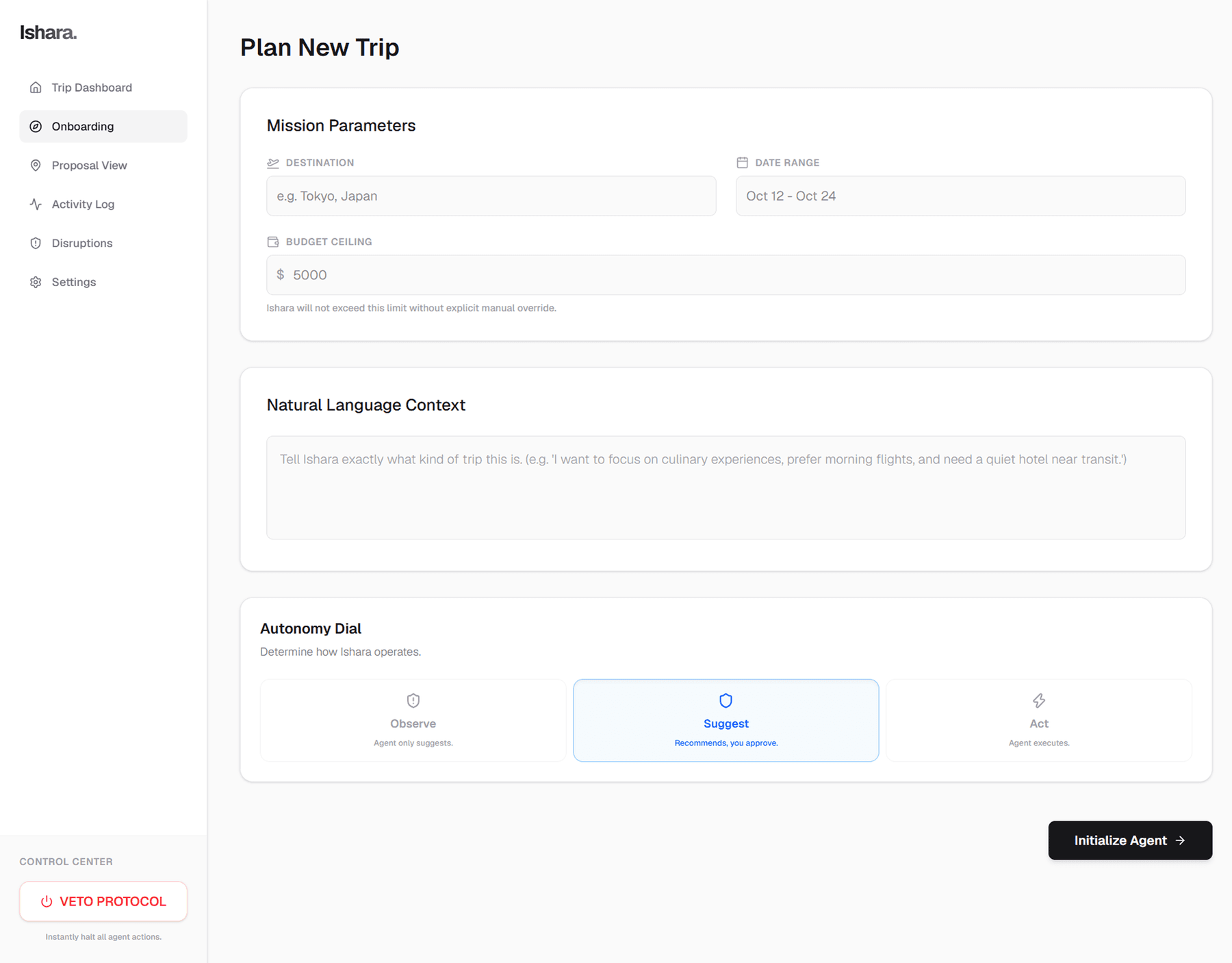
Onboarding
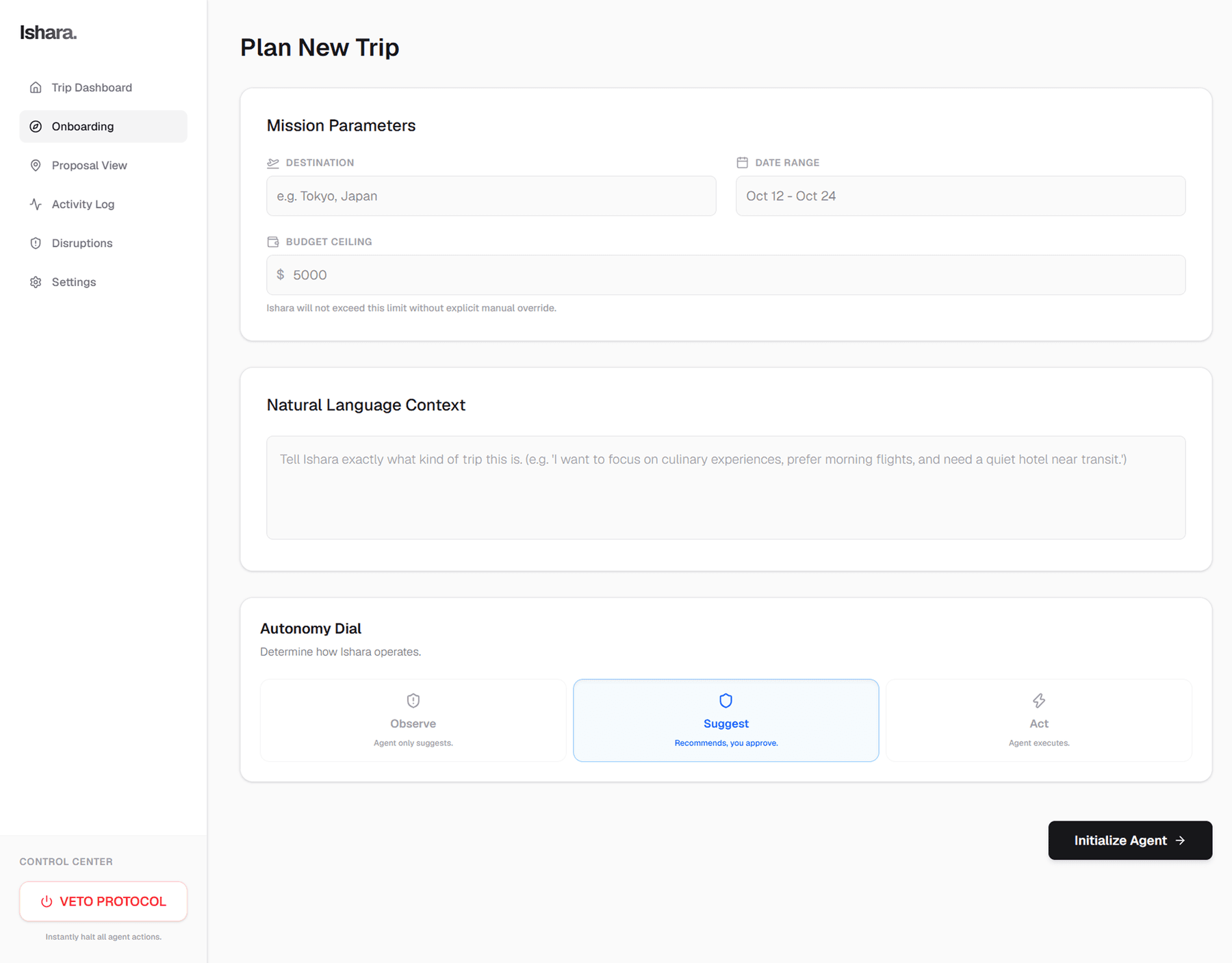
Structured Parameters over Linear Chat
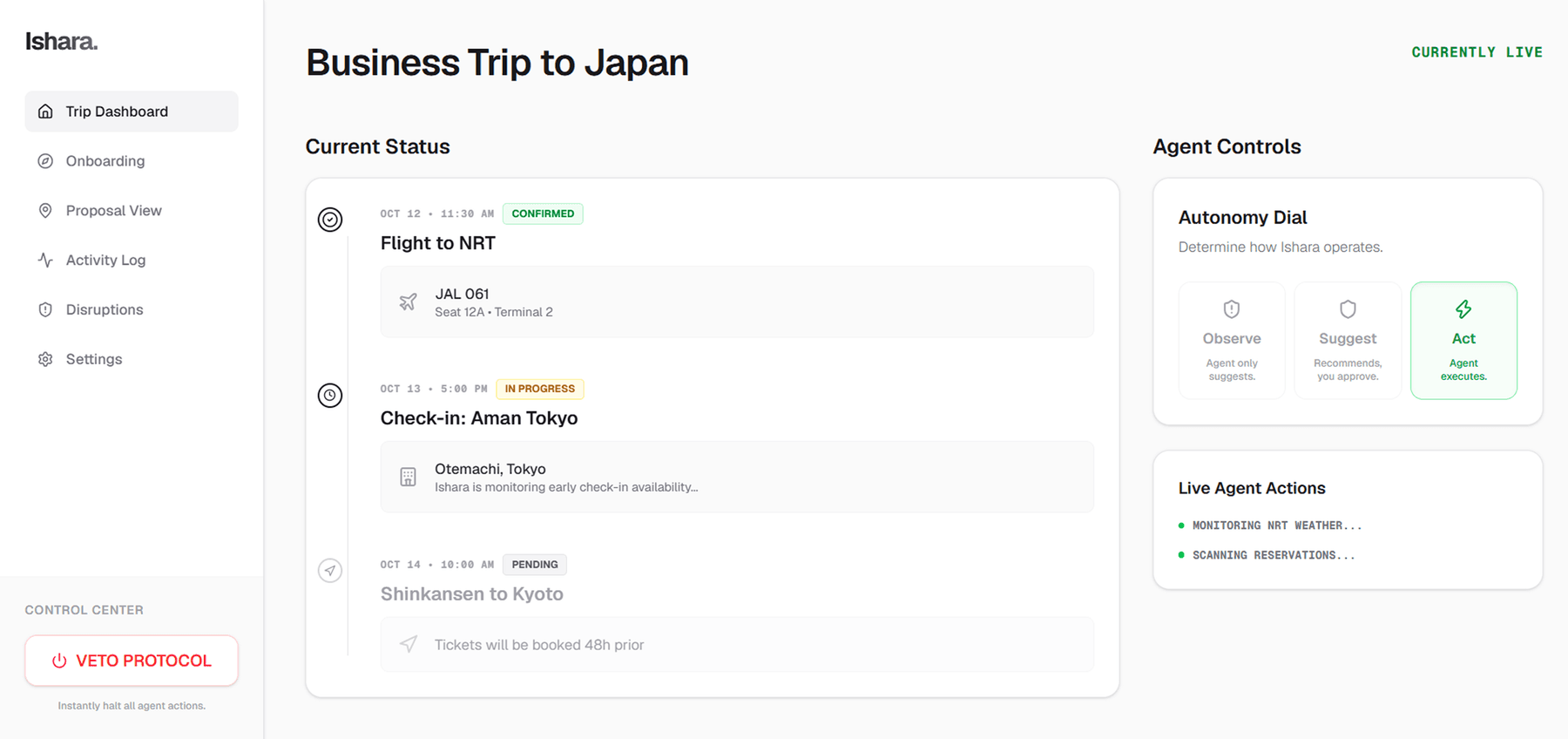
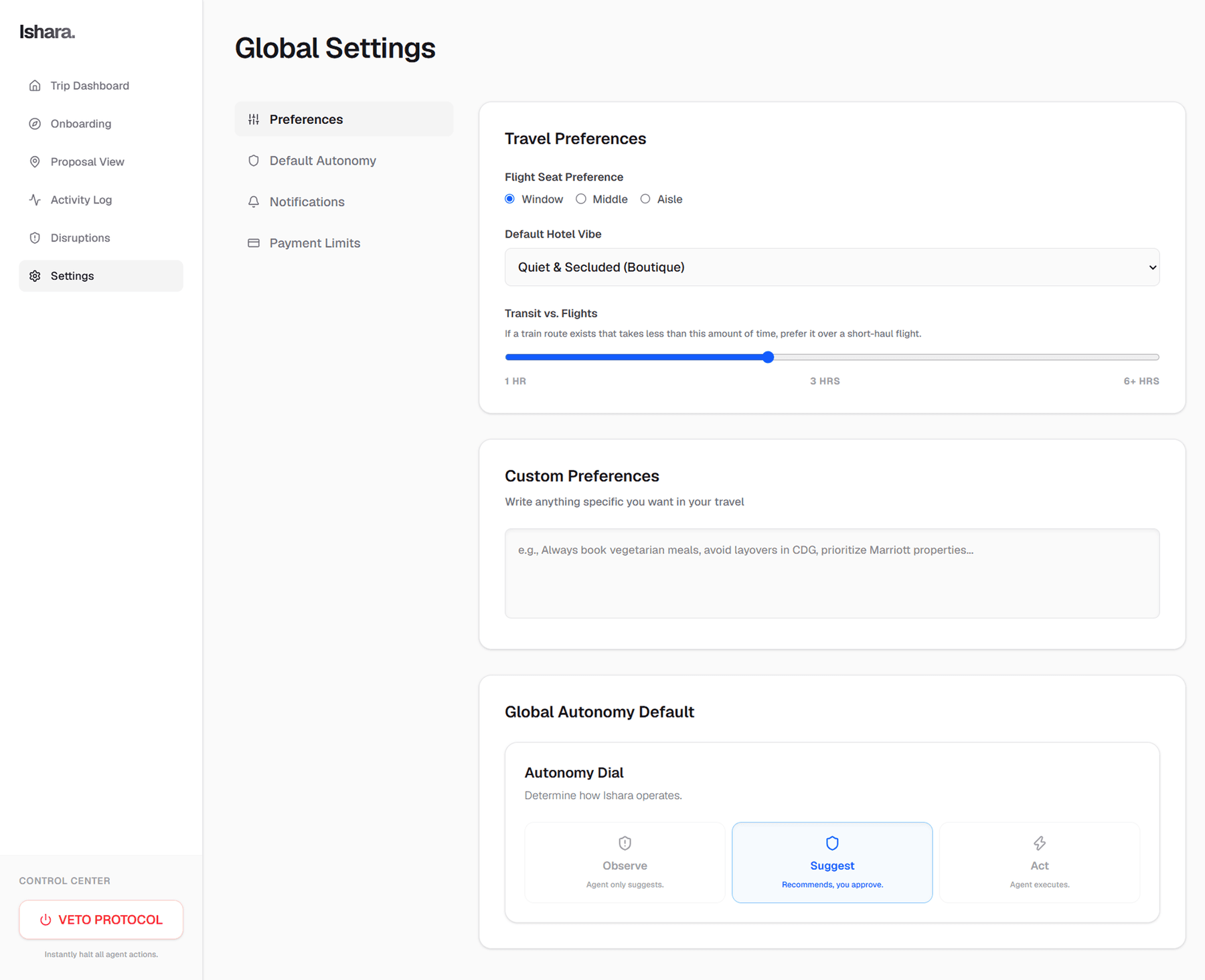
Users do not just ask Ishara to plan a trip; they program its constraints. By setting strict budget ceilings, natural language context, and a defined autonomy level (Observe, Suggest, Act), the user establishes the exact guardrails the AI must respect.
STRENGTHS
STRATEGIC PILLARS
The Ishara architecture is built upon six foundational pillars, designed to elevate AI interaction from mere conversation to systemic supervision and explainable action.
Intent Preview
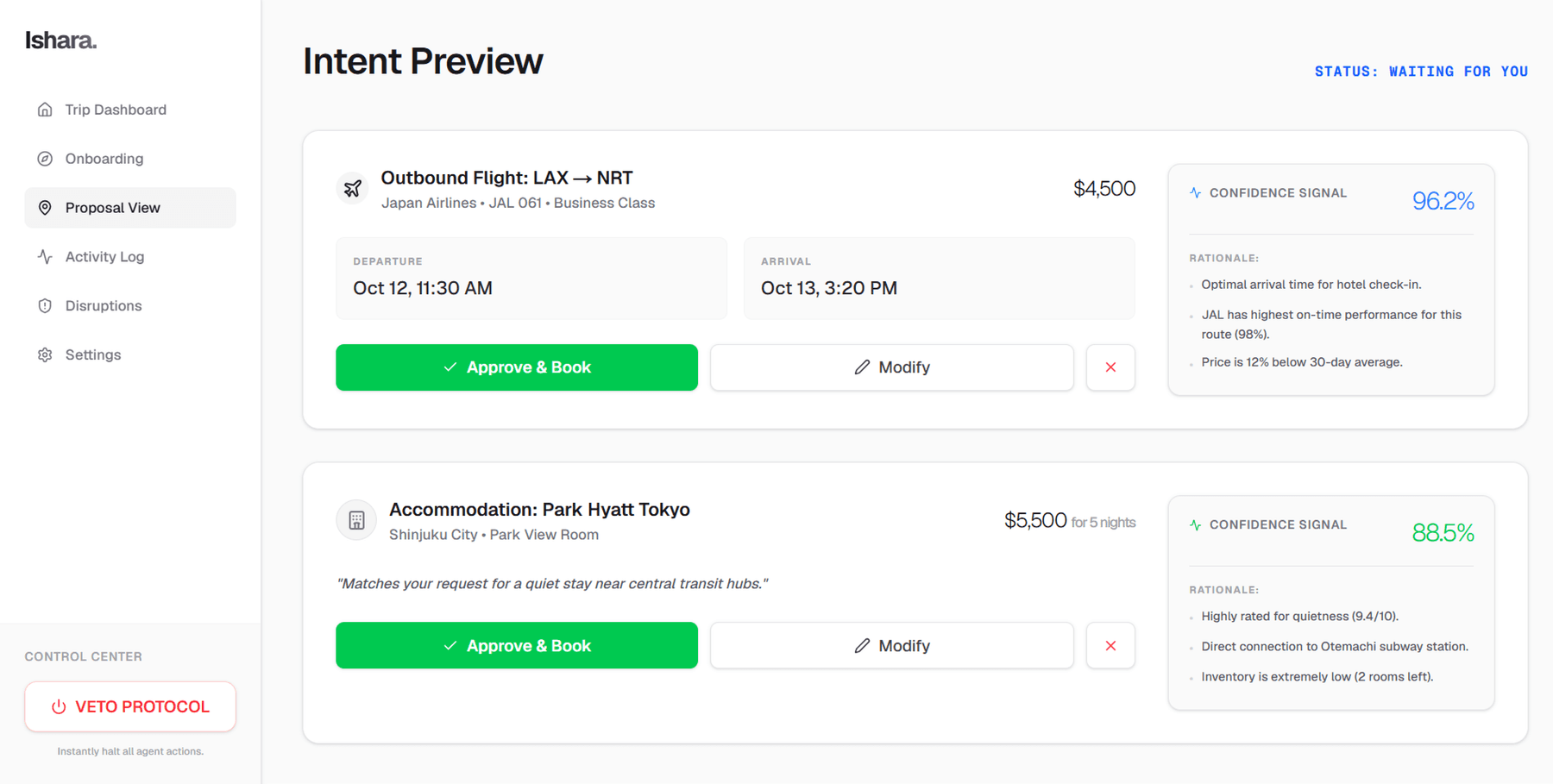
Before Ishara acts, it shows exactly what it intends to do. The user can review the proposed action, understand its consequences, and approve, modify, or reject it before anything consequential happens.
Autonomy Dial
- Observe: Ishara only suggests.
- Suggest: Ishara recommends and prepares, but the user approves each action.
- Act: Ishara executes within the user's predefined boundaries.
Confidence Signals
Ishara makes its certainty visible. The interface communicates how confident the agent is in a recommendation or decision, helping the user understand when Ishara is highly certain and when additional scrutiny may be appropriate.
Explainable Rationale
Every meaningful decision comes with a plain-language reason. Instead of presenting an unexplained result, Ishara tells the user why it made a particular choice, using relevant factors such as budget, location, timing, preferences, or reviews.
Veto Protocol
The user can stop Ishara immediately. A persistent kill switch lets the user halt agent activity from anywhere. Pending actions pause, and the user can review what happened before deciding who continues.
HOTL Dashboard
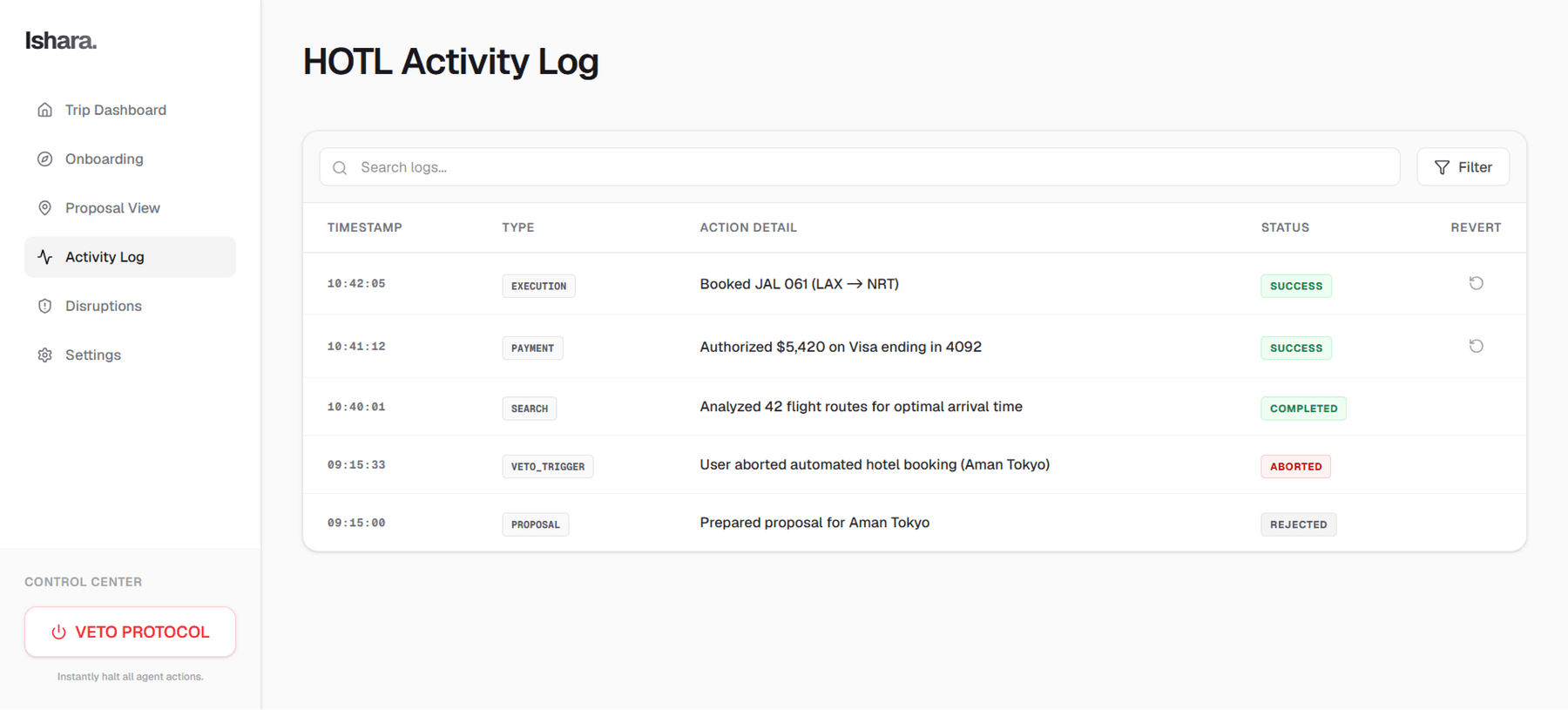
Human On The Loop: one place to see what Ishara has done, is doing, and plans to do. The activity view makes agent actions visible, reviewable, and reversible, so the human can supervise without having to micromanage every step.
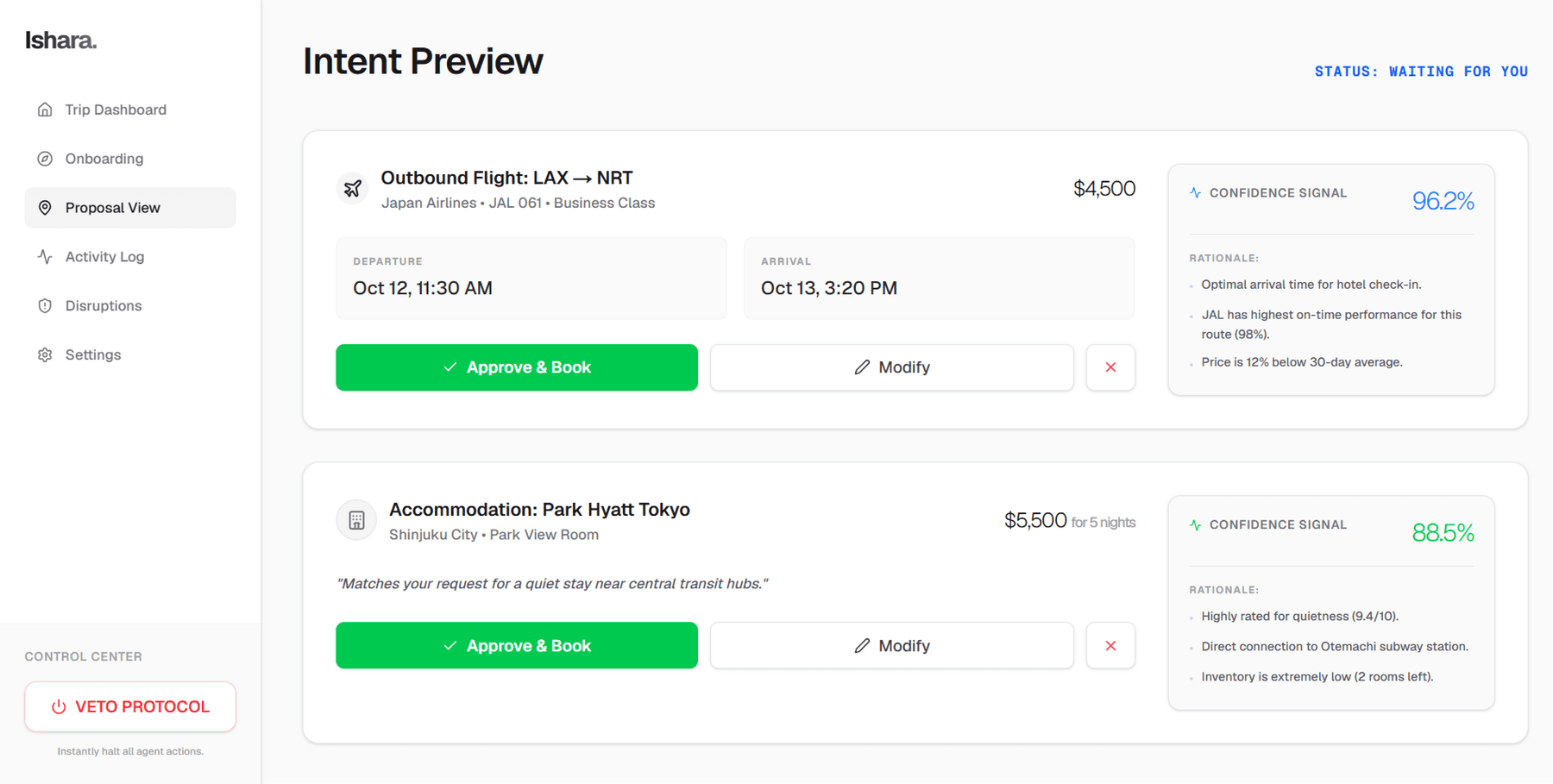
WAITS FOR YOU TO CONFIRM
The
Proposal
View
A key manifestation of Radical Explainability. The Proposal View surfaces underlying AI rationale and confidence metrics directly to the operator.
Confidence Signals
Real-time telemetry indicating the model's certainty, parsed against historical task execution.
Explainable Rationale
Step-by-step logic breakdown citing specific data points or precedents used in the proposal generation.
HOTL
Passive data collection and baseline metric establishment. System models behavior without intervention.
Proactive insights generated. The system models potential actions but requires human approval to execute.
Full autonomy within bounded operational parameters. Actions are logged to the audit ledger.
The Autonomy Dial provides granular control over system agency. By default, the system operates in 'Suggest' mode, ensuring human oversight for high-stakes operational adjustments.
HOTL Audit Ledger
The Human-On-The-Loop (HOTL) architecture mandates an immutable, highly legible audit trail. Every autonomous suggestion, human intervention, and resulting system action is recorded to ensure Verifiable Reasoning.
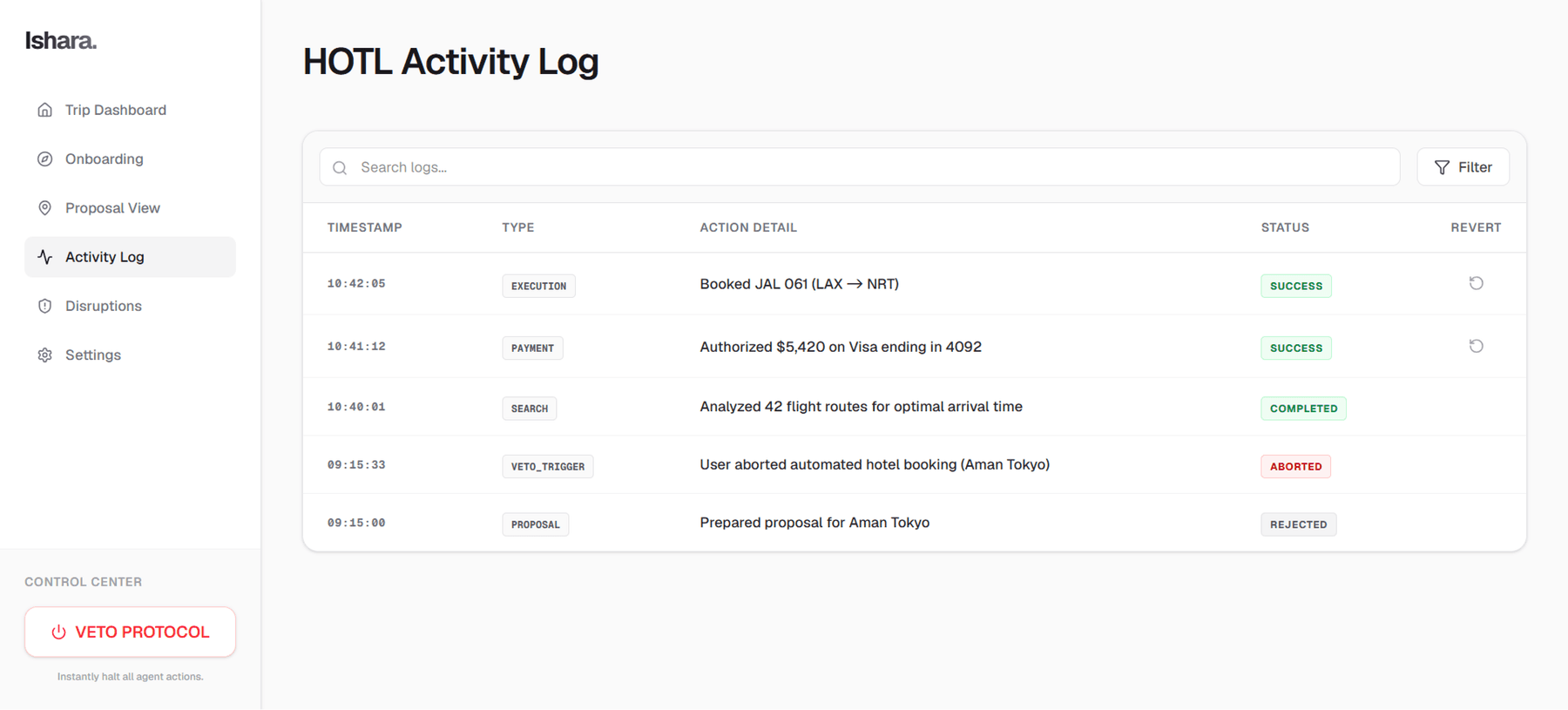
Contextual Traceability
Every log entry provides direct links back to the raw telemetry data and the specific ML model confidence score that triggered the event.
Action Legibility
System actions are translated into plain-text summaries, avoiding opaque technical jargon to ensure immediate comprehension by operational staff.
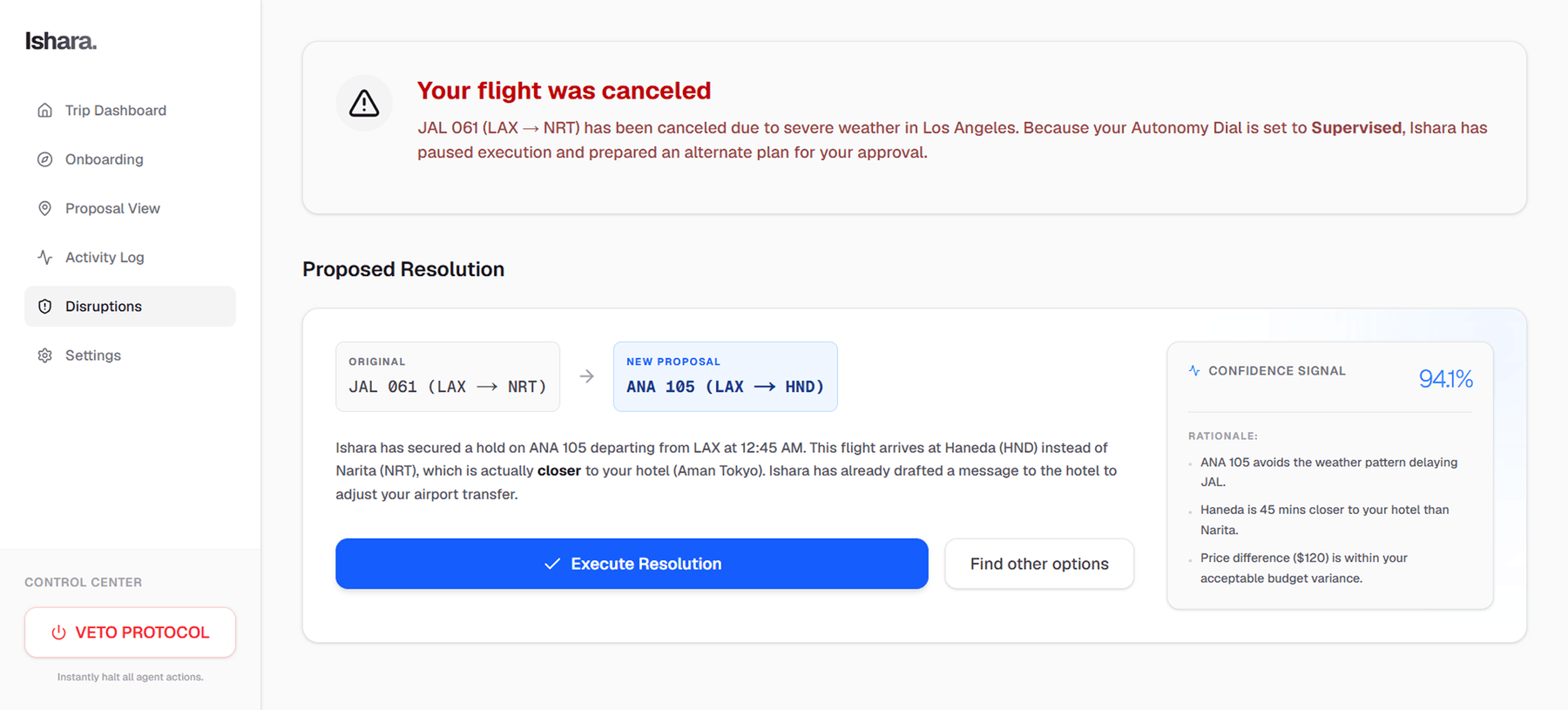
SOLVER
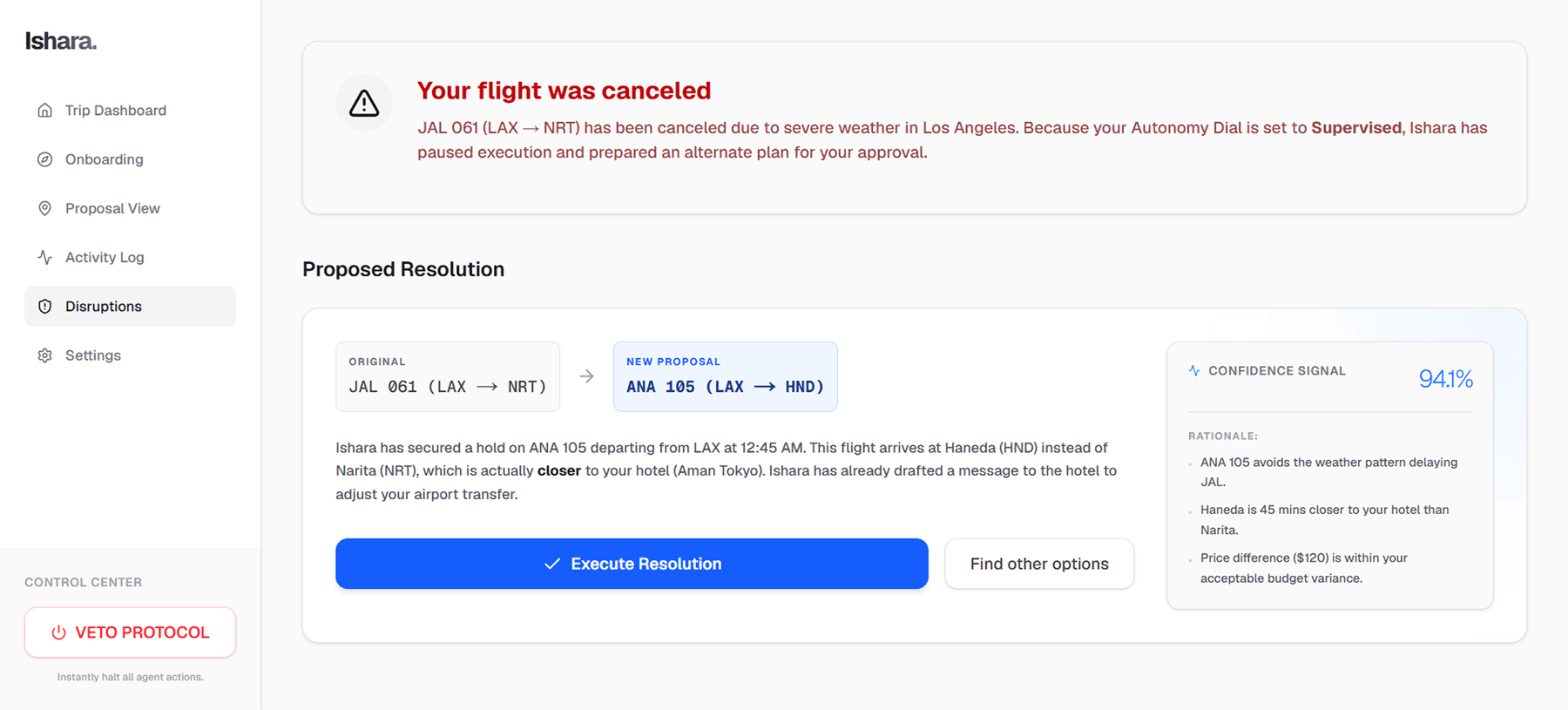
Disruption Resolver
When anomalies breach defined operational thresholds, the Disruption Resolver presents structured mitigation paths. The UI focuses on rapid comprehension of the cascading impact of each option.
FINAL DESIGN
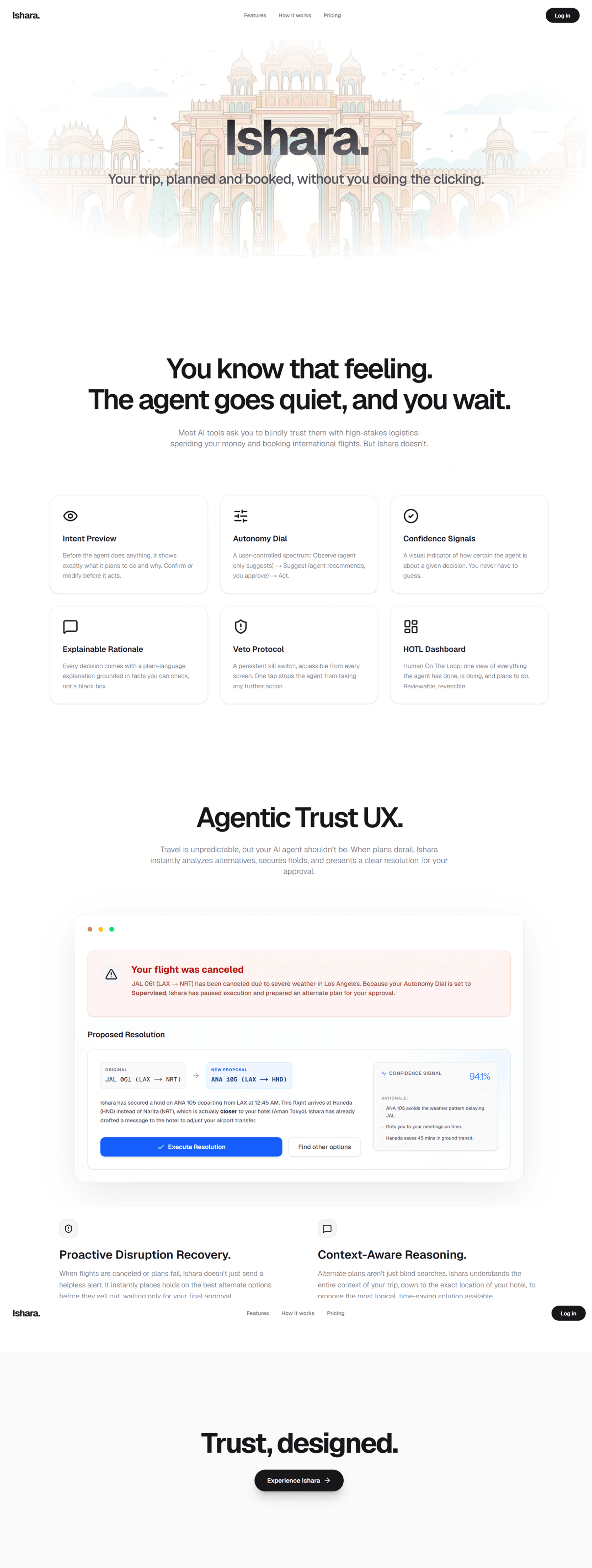
The Final Interface.
By prioritizing control, transparency, and traceability, the Ishara interface acts as a transparent layer over complex autonomous reasoning, translating machine learning into human-understandable insights.
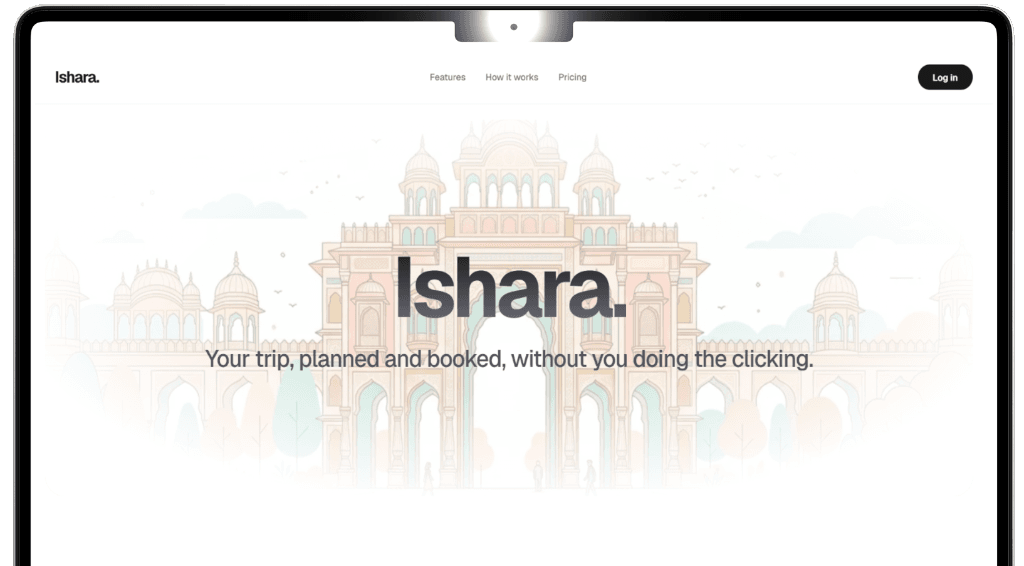
Landing Screen
Dashboard Screen
Onboarding Screen
Proposal Screen
HOTL Screen
Disruptions Screen
Settings Screen
Anyone can design a nice-looking AI
travel website.
Very few have a real, working point of
view on how to make one trustworthy.